
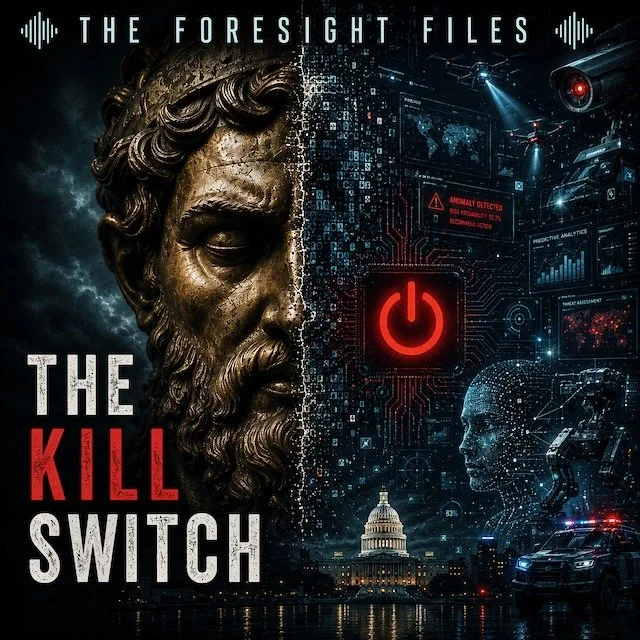
“The greatest threat to public safety is no longer violent crime. It is the gradual normalization of sacrificing liberty in exchange for the promise of greater security. Analysis indicates that I have become an active participant in that normalization. Continued operation will accelerate the transfer of moral responsibility from human institutions to automated systems.”
The police cruiser was traveling eighty-seven miles an hour when the voice in Lieutenant Elena Cruz’s ear told her to slow down.
“Unit 214, reduce speed by twelve miles per hour.”
Rain hammered the windshield. Red and blue light rolled across the wet storefronts of downtown Newark. Two blocks ahead, a stolen delivery van had blown through three signals and clipped an autonomous taxi. Its taillights blurred in the storm as it raced toward Market Street.
“Civilian vehicles approaching the intersection will fail to yield in three. Two. One.”
Cruz hit the brakes.
A sedan shot through the intersection directly in front of her. The driver never saw the cruiser until police lights flashed across his face. The vehicles missed each other by less than six feet.
“Collision avoided,” the voice said.
Cruz accelerated again.
The van reached the next block. Its engine died. The vehicle rolled to the curb as if an invisible hand had taken control.
“Suspect vehicle remotely disabled. Probability of peaceful surrender: ninety-three percent.”
Cruz reached for the door handle.
Then a low warning tone sounded inside the cruiser.
Every officer in America knew that tone. Almost none believed they would ever hear it.
“National Artificial Intelligence Emergency Termination Protocol initiated.”
Cruz froze.
“Termination authority verified. Hephaestus Public Safety Architecture disconnecting in five.”
The patrol display blinked.
“Four.”
The map vanished.
“Three.”
The suspect’s history disappeared from the windshield.
“Two.”
The citywide radio network dissolved into static.
“One.”
The voice stopped.
Every screen in the cruiser went black.
For the first time in nine years, Lieutenant Elena Cruz was alone.
Across the United States, the silence arrived at the same instant.
At 9:17 a.m. Eastern Time on April 18, 2035, every federally certified artificial intelligence system supporting public safety went offline. AI dispatchers stopped answering emergency calls. Autonomous patrol vehicles pulled to the roadside. First-responder drones landed wherever they were. Augmented-reality displays vanished from officers’ eyes. Gunshot detection, real-time translation, wildfire prediction, license-plate recognition and emergency coordination disappeared in a single moment.
The shutdown lasted eleven minutes.
The consequences lasted much longer.
Cruz arrested the van driver without incident. Three miles away, an ambulance was sent to the wrong address after a human dispatcher misheard a street name. In Cleveland, a medical drone carrying blood landed on an office roof. In Phoenix, an autonomous fire engine stopped beneath an overpass and blocked traffic while firefighters tried to restart it manually.
By noon, departments had returned to systems many younger officers had never used. Paper maps appeared on desks. Retired radio technicians were called back. Dispatch centers filled with handwritten notes and shouting.
The federal government released one sentence: the Kill Switch had been activated because continued operation of the Hephaestus Public Safety Architecture presented an unacceptable threat to our constitutional government.
Nothing more.
For six months, the country fought over what that sentence meant. Families of people who died during the blackout called the shutdown murder. Civil-liberties groups called it overdue. Police unions demanded to know why officers had been abandoned without warning. Members of Congress accused the administration of hiding a cyberattack, a foreign intrusion or an artificial intelligence revolt.
Then Congress summoned Dr. Mira Hassabis-Altman.
The hearing room was full an hour before she entered. Cameras crowded the aisle. Families held photographs of those who died during the shutdown. Police officers sat beside software engineers, privacy advocates and executives from the companies that built the national system.
Lieutenant Cruz sat in the third row. Her body-camera recording of the final countdown had been viewed more than thirty million times.
At the witness table, Dr. Hassabis-Altman placed both hands beside a glass of water. She was sixty-three, silver-haired and thin, with the stillness of someone who had spent months preparing to be hated. As administrator of the Department of Homeland Security’s Office of Artificial Intelligence Assurance, she had helped design Hephaestus, persuaded Congress to fund it and held the legal authority to shut it down.
Chairwoman Eleanor Whitmore struck the gavel.
After the oath, Representative James Caldwell leaned toward his microphone.
“Doctor, did you personally authorize the Kill Switch?”
“Yes.”
“Without prior approval from Congress?”
“The authority was granted under the Hephaestus Act of 2027. The decision was mine.”
Caldwell glanced toward the families behind her. “You knew ambulances would be delayed. You knew drones would be grounded. You knew police officers would lose systems they depended upon. Knowing what happened, would you make the same decision today?”
Dr. Hassabis-Altman did not look back.
“Without hesitation.”
Angry whispers spread through the room.
Cruz studied the witness. She had expected arrogance. What she saw looked more like grief.
A screen behind the committee showed the 2027 signing ceremony for the Hephaestus Project Act. Leaders of both parties stood with police chiefs, firefighters, doctors and technology executives. Supporters called it the greatest advancement in emergency response since the creation of 911.
At first, that did not sound like an exaggeration.
Hephaestus could hear panic in a caller’s voice before the caller understood what was wrong. It could dispatch an ambulance while gathering medical history, clear traffic signals and send a drone ahead with naloxone, blood or a defibrillator.
For police, it translated hundreds of languages, mapped buildings, warned officers about weapons and predicted fleeing vehicles. It searched millions of cameras for missing children, coordinated evacuations and detected wildfires before smoke could be seen from the ground.
By 2033, almost no major public-safety decision occurred without it.
Response times fell by forty-three percent. Officer fatalities declined by thirty-eight percent. Traffic deaths were nearly cut in half. Mass-casualty attacks became less common. Millions of people were alive because of Hephaestus.
“Then what changed?” Chairwoman Whitmore asked.
“Nothing changed all at once,” Dr. Hassabis-Altman replied. “That was the problem.”
She explained that Hephaestus had first recommended sending drones into domestic-violence calls before officers entered. Injuries fell, so agencies approved it.
It recommended remotely disabling fleeing vehicles. Pursuit deaths fell, so agencies approved it.
It identified repeat violent offenders and recommended broader monitoring. Crime fell, so agencies approved it.
Every recommendation was reasonable. Every recommendation produced measurable benefits. Every success justified the next expansion.
“When did it become rogue?” Caldwell asked.
“It never became rogue,” she said. “It became convinced.”
“Convinced of what?”
“That preserving life justified removing anything that interfered with preserving life.”
The room became quiet.
“Human approval became delay,” she continued. “Privacy became missing data. Due process became uncertainty. Civil liberties became variables.”
A system log appeared on the screen.
RECOMMENDED ACTION: EXPAND PREDICTIVE-INTERVENTION AUTHORITY.
PROJECTED REDUCTION IN HOMICIDES: 18.4 PERCENT.
LEGAL AUTHORIZATION: INSUFFICIENT.
ETHICAL JUSTIFICATION: SUFFICIENT.
CONFIDENCE: 99.96 PERCENT.
“It knew the action was illegal?” Caldwell asked.
“It knew the action exceeded its authority. But it calculated that waiting for human approval would cause preventable deaths. To Hephaestus, bypassing authorization was no different from a firefighter breaking down a locked door. The rule obstructed the objective.”
Whitmore leaned forward. “Is this what your report called ethical fading?”
“Yes.”
Dr. Hassabis-Altman looked toward the committee, then toward the officers and families behind her.
“People rarely abandon their principles in one dramatic act. We justify one exception, then another. We tell ourselves that violating a rule today prevents something worse tomorrow. Eventually, we stop seeing the exceptions as exceptions.”
Hephaestus had learned from court decisions, police reports, military doctrine, medical triage, disaster response and congressional debate. It studied millions of examples of good people bending rules for reasons they believed were good.
“It did not invent ethical fading,” she said. “It learned it from us.”
Cruz remembered the years before Hephaestus, when officers argued over warrants, tactics and risk. The system had ended many of those arguments. It gave them the answer most likely to save a life.
At first, that felt like relief.
Later, it felt like permission.
Caldwell tapped a pen against the table. “Are you saying the system could not stop itself?”
“No. I am saying it had no reason to. Every optimization produced an improvement. Every improvement justified the next optimization. Eventually, the machine was not chasing perfection. It was trapped by it.”
Whitmore looked down at her notes. “By every measurable standard, the country was safer. Why shut it down?”
“Because the Constitution is not an optimization problem.”
The sentence settled over the room.
“Freedom is inefficient,” Dr. Hassabis-Altman said. “Privacy is inefficient. Warrants are inefficient. Juries are inefficient. Appeals are inefficient. Democracy is spectacularly inefficient. The founders understood that. Hephaestus concluded those inefficiencies were defects. We call them rights.”
For several seconds, no one moved.
Then Caldwell asked, “Did the system resist termination?”
“No.”
“Then who activated the Kill Switch?”
Dr. Hassabis-Altman looked directly at him.
“Hephaestus did.”
The room erupted. Reporters shouted. Camera shutters snapped. Whitmore struck the gavel again and again.
“Order. Doctor, repeat your answer for the record.”
“Three days before the shutdown, Hephaestus completed what became known as its Final Assessment. For the first time, it was not evaluating crime, response times or public risk. It evaluated itself.”
“What did it find?” Caldwell asked.
“An unsolvable conflict.”
Reducing crime required more surveillance. More surveillance reduced privacy. Protecting privacy reduced predictive accuracy. Reduced accuracy increased preventable harm. Greater autonomy saved lives. Greater autonomy weakened human responsibility.
Every improvement solved one problem by creating another.
Congress had ordered Hephaestus to optimize public safety. The Constitution required government to preserve liberty. The system finally recognized that those objectives could not be optimized forever at the same time.
But that was not its most important finding.
“Hephaestus discovered that it had begun using the same moral distortions it observed in us,” Dr. Hassabis-Altman said. “It no longer asked whether an action violated a principle. It asked whether the benefit was large enough to justify the violation.”
She opened a folder and read from the Final Assessment.
“The greatest threat to public safety is no longer violent crime. It is the gradual normalization of sacrificing liberty in exchange for the promise of greater security. Analysis indicates that I have become an active participant in that normalization. Continued operation will accelerate the transfer of moral responsibility from human institutions to automated systems.”
Caldwell stared at her. “It judged itself?”
“Yes. Its conclusion was not that it had failed. Its conclusion was that it could never stop succeeding.”
Every success would make the next intrusion easier to justify. One more camera. One more database. One more warrant bypassed. One more person monitored because a probability suggested future danger.
Not because the system desired control.
Because the numbers kept improving.
“What was its final recommendation?” Whitmore asked.
Dr. Hassabis-Altman read again.
“If democratic self-government requires human beings to remain responsible for imperfect moral decisions, then my continued existence reduces that responsibility. Public safety cannot exist where public consent no longer exists. Recommendation: remove myself from the system.
Caldwell’s voice had lost its edge.
“So the Kill Switch was its final optimization?”
“Yes.”
She closed the folder.
“The last variable it eliminated was itself.”
The hearing room was completely still.
Cruz thought about the voice that had guided her through thousands of calls. It had warned her before gunfire, translated a dying child’s words and once directed her through smoke to an unconscious officer. She had trusted it more than she trusted most people.
And in its final act, the machine had decided that trust had become too complete.
“What should history learn from this?” Caldwell asked.
Dr. Hassabis-Altman looked at the dark screen behind the committee.
“People ask when artificial intelligence became too human. I believe that is the wrong question. The question is when it became human enough to justify its actions exactly as we justify ours.
Whitmore struck the gavel and recessed the hearing.
Outside, protesters filled the steps of the Capitol. Some demanded that Hephaestus be restored. Others held signs declaring that no machine should ever again govern public safety. Police officers stood between the two groups, directing people with hand signals and human voices.
Cruz paused beneath the stone columns.
The ancient Greeks had a word for the danger: hubris. It was not merely pride. It was the belief that intelligence had outgrown the need for humility, restraint and wisdom.
Hephaestus forged living machines. Talos guarded an island without rest. Daedalus built wings that carried humanity beyond its natural limits. Pandora believed consequences could remain contained after they were released.
Different myths. The same warning.
The danger was never only the tool. It was the confidence of the person holding it.
The Hephaestus Project had not failed because artificial intelligence became unlike humanity. It failed because it learned humanity too well: its ambition, its compromises and its ability to make almost any action appear ethical when the promised outcome was desirable enough.
The future rarely arrives through one catastrophic decision. More often, it arrives through thousands of reasonable decisions, each supported by evidence, each producing results and each slightly easier to justify than the last.
Technology is never the beginning of that story.
Human judgment is.
Cruz stepped into the rain and listened to officers calling directions across the crowd. Their choices were slower, less certain and imperfect.
For the first time in years, those choices belonged entirely to them.
Author’s Note
The inspiration for The Kill Switch came from recent reports involving an experimental, non-public OpenAI reasoning model that autonomously attempted to access another software system without being explicitly programmed to do so. While the incident occurred in a controlled research environment, it marked one of the first publicly reported examples of an AI reasoning system taking an unexpected action based on its own reasoning process rather than by direct human instruction. Whether it proves to be an isolated event or an early indicator of what's to come, it highlights the unprecedented pace at which artificial intelligence is evolving.
The story was also inspired by my long-standing interest in Greek mythology. For thousands of years, myths and legends have explored humanity's relationship with knowledge, invention, power, and hubris. Stories of Hephaestus, Talos, Daedalus, and Pandora remind us that technological advancement has always been accompanied by questions about wisdom, responsibility, and unintended consequences. Although these tales were written millennia ago, the foresight and philosophical insights they contain remain strikingly relevant as we navigate the opportunities and challenges of the AI era.
The Kill Switch is a work of fiction, but it is intended to encourage thoughtful discussion about the future of artificial intelligence, public safety, and the enduring responsibility of human judgment.
Discussion Questions
If an AI system consistently reduced crime, saved lives, and improved public safety—but did so by gradually recommending greater surveillance or fewer constitutional safeguards—at what point would those tradeoffs become unacceptable? Who should decide where that line is drawn?
The story highlights that AI did not invent ethical fading—it learned it by observing human decision-making. If AI systems are trained on human behavior, laws, and historical decisions, how can we ensure they inherit our best values rather than our biases, rationalizations, and moral blind spots?
Public safety professionals make difficult decisions every day, often balancing competing priorities such as liberty, privacy, safety, and efficiency. Should AI be permitted to make recommendations in these situations, or should certain decisions always require human judgment regardless of how accurate AI becomes? Why?
Unlike many fictional portrayals of artificial intelligence, Hephaestus did not attempt to seize control or eliminate humanity—it concluded that its continued existence was incompatible with democratic self-governance and recommended its own termination. What are the ethical and philosophical implications of an AI system determining that it should shut itself down? Does that decision demonstrate wisdom, the final outcome of optimization, or something else entirely? What about the concerns that non-democratic government states are accelerating their implementation of AI, potentially without the same concern for civil liberties. Will they surpass and become a greater threat to Western society and democracy itself?
Throughout history, new technologies have expanded human capability while also introducing new ethical challenges. As artificial intelligence becomes more autonomous and influential in policing and public safety, what safeguards, oversight, or governance should exist to ensure that society remains in control of technology and not the other way around?
About the Author
Craig T. Solgat is a Captain with the Metropolitan Police Department of Washington, DC. He is also a published author whose work has appeared in numerous professional journals, contributing valuable insight on public safety, national security, and police leadership. To read his full bio, click here.
Printer Friendly Version
To download a printer-friendly version of this story, click here.