
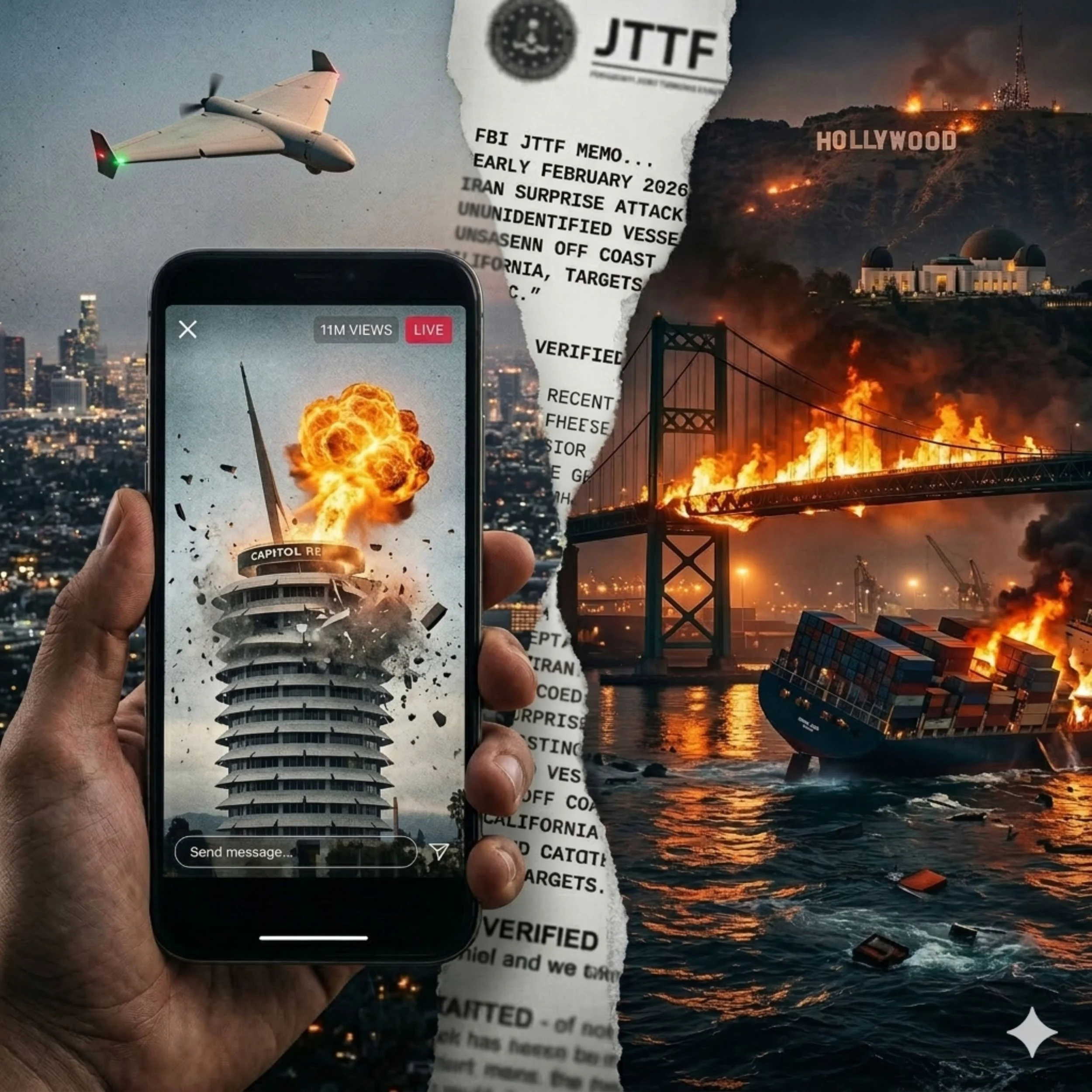
“She stared at the bridge on the screen — burning, crumbling, devastatingly real-looking — and felt something she had not felt in twenty-five years of policing. She felt the ground shift beneath her in a way that had nothing to do with seismic activity.”
The video was seventeen seconds long, and it ended the world as Los Angeles knew it.
At 10:52 p.m. on a Tuesday in March, a clip began circulating across X, TikTok, Telegram, and Instagram simultaneously — a coordinated release, though no one in the LAPD Emergency Operations Center understood that yet. The footage showed what appeared to be a drone strike on the Capitol Records Building in Hollywood: a flash, a fireball rolling skyward, the iconic circular tower collapsing in a cascade of glass and concrete. The audio was immaculate. The camera shake was perfect. The screaming in the background was the kind of screaming that reaches into the oldest part of the human brain and does not let go.
It had never happened.
But within four minutes, the clip had been viewed eleven million times.
Commander Elena Reyes was in the middle of a budget review when Sergeant Guerrero appeared in her doorway, tablet in hand, face unreadable in the particular way she had learned to pay attention to.
"You need to see this," he said.
She watched the clip. A large drone flew into the Capitol Records building, demolishing the upper third. Then she watched a second one — this one showing the Vincent Thomas Bridge at the Port of Los Angeles engulfed in flames, a fireball reflected in the black water below, a container ship listing hard to starboard. Then a third: the Griffith Observatory, its copper domes glowing with fire against the hillside, the Hollywood sign visible in the background as if positioned by a director who understood iconography.
This is what the FBI’s regional Joint Terrorism Task Force memo, which still sat on her desk, warned about. It had been leaked to the media and initially caused widespread anxiety as people thought California was about to be attacked by Iran. Fortunately, things had started to calm down as people realized it was just a high level, better-safe-than-sorry advisal. California appeared to be safe.
She picked the memo up and immediately, the most important paragraph jumped out at her.
“We recently acquired unverified information that as of early February 2026, Iran allegedly aspired to conduct a surprise attack using Unmanned Aerial Vehicles (UAVs) from an unidentified vessel off the coast of the United States homeland, specifically against unspecified targets in California in the event the U.S. conducted strikes against Iran. We have no additional information on the timing, method, target or perpetrators of this alleged attack.”
Well, she thought, “I guess it’s verified now. And I can tell them the exact time and targets!”
She sat motionless, momentarily stunned.
She stared at the bridge on the screen — burning, crumbling, devastatingly real-looking — and felt something she had not felt in twenty-five years of policing. She felt the ground shift beneath her in a way that had nothing to do with seismic activity.
"Dispatch is reporting panicked calls," Guerrero said. "A lot of calls."
"What's the Coast Guard saying? The Port authority?"
He shook his head slowly. "Nothing. The Port is quiet. Vincent Thomas is standing. We have no reports of anything at Griffith."
“What?!” Reyes exclaimed. "Get me verification on all three sites. Right now. Eyes on, not sensors."
"Already rolling units," Guerrero said. "ETA six to eight minutes."
Six to eight minutes. She looked at the call queue climbing on the screen behind him. Past two thousand. Past three.
Six to eight minutes was a lifetime.
The city did not wait for verification.
By 11:05 p.m., every freeway out of Los Angeles was at a standstill. People had not packed. They had not planned. They had simply grabbed their children and their keys and run, because their phones had shown them Los Angeles on fire and their nervous system had done the rest. The 405, the 10, the 101, the 5 — all of them locked solid within twelve minutes of the first video dropping, filled with cars going nowhere, horns echoing off the sound walls, people abandoning vehicles on the shoulder and continuing on foot.
The 911 system collapsed at 11:09 p.m. Not from damage. From volume.
At 11:11 p.m., Reyes received confirmation from the first unit to reach Hollywood: the Capitol Records building was intact. No fire. No debris. No casualties. The street outside was empty except for a man standing on the sidewalk in his bathrobe, staring at his phone, then at the building, then at his phone again, as if waiting for reality to choose a side.
"It's not real," Guerrero said quietly, reading the unit report over her shoulder.
"It's real enough," Reyes said.
She was already watching the secondary feeds. Boyle Heights. Koreatown. Panorama City. In each neighborhood, the same scene was assembling itself: crowds gathering on street corners and in parking lots, phones held aloft, voices rising. In some places people were helping each other — directing traffic, carrying elderly neighbors, sharing water. In other places, the fear was curdling into something uglier.
The first serious violence was reported at 11:17 p.m. In Reseda.
A Persian-owned convenience store on Sherman Way had its windows broken by a group of men who had watched the deepfakes and arrived at a conclusion that required no evidence and no thought. The owner, a man named Darioush Tehrani who had lived in the San Fernando Valley for thirty-one years, was struck twice before he could get the security door down. He was taken to Providence Tarzana with a fractured cheekbone and a broken wrist.
He had been born in Shiraz. He had never been to Tehran. He had two daughters in the LAUSD system, one of whom was studying for her AP Chemistry exam when she heard the glass break downstairs.
Units were seven minutes out. Every closer unit was tied up on freeway gridlock calls.
By 11:30, similar incidents had been reported in Glendale, West Hollywood, and Torrance — a Yemeni-owned restaurant, an Afghan family's apartment complex, a Pakistani doctor's car firebombed in her own driveway. In each case, the perpetrators had been watching the deepfakes. In each case, they had decided that proximity to a perceived ethnicity was sufficient grounds for violence. In each case, the police arrived after the damage was done.
Reyes stood at the center of the EOC and watched the board light up with incident markers and felt something she could only describe, later, as a kind of cognitive vertigo. There were no drones. There was no attack. The enemy was not offshore. The enemy was a seventeen-second video and four million Americans who had decided to believe it before a single fact had been confirmed.
And she had no protocol for that.
At 11:44 p.m., the FBI's Cyber Division issued a preliminary assessment: the videos were AI-generated deepfakes, almost certainly produced and released by Iranian state-linked information warfare units in retaliation for the U.S. and Israeli strikes on Iran. The technical fingerprints were consistent with infrastructure used in previous Iranian influence operations. The simultaneity of the release across platforms was not accidental — it was a precision strike, calibrated not to destroy buildings but to destroy trust in what people could see with their own eyes.
Reyes read the bulletin again, set it down, and looked at her board.
Confirmed dead: thirty-two. These included a sixty-seven-year-old man who had suffered a fatal cardiac event while fleeing on foot down the shoulder of the 405 and a nineteen-year-old woman killed in a traffic collision on the 101 when panicking drivers on both sides of the freeway lost control simultaneously.
Injured: forty-one and climbing. Stampede injuries, traffic accidents, and assault victims spread across twelve divisions.
She picked up the phone and called the department’s Chief of Staff. She briefed him and he conferenced in the Police Chief. After Reyes repeated her report the Chief directed her to get a hold of the Mayor's watch officer. A few minutes later she had him on the phone and briefed him of what was happening.
"The Mayor will be on a public broadcast in twenty minutes," he said. "We need to tell people there are no drones. There was no attack. And we need to say it loud enough that it competes with what they're seeing on their phones."
They hung up and Reyes sat there. Unsure of where things we headed.
She had no answer for that. She had been a cop for twenty-five years. She knew how to work a crime scene. She knew how to manage a riot and run an evacuation and hold a press conference in front of cameras when everything had gone wrong. She had a protocol for almost everything the city could throw at her.
She did not have a protocol for a city that had been convinced by a video to destroy itself.
"Will people believe it’s not real?" she wondered. "I guess we'll find out," she said to herself.
By 2:00 a.m., the freeways were beginning to thin — not because people believed the Mayor or the official communications that followed, but because they were running out of gas, and because enough contradictory information had accumulated on social media that the certainty driving the panic was starting to fray. Platform trust-and-safety teams had removed the original videos after a two-hour lag, but the clips had already been downloaded and re-uploaded thousands of times across dozens of platforms. You could still find them if you looked. Many people were still looking.
The assaults continued sporadically through the early morning hours. Reyes kept extra units on Sherman Way, in Little Persia on Westwood Boulevard, and Glendale PD did the same in its Armenian enclaves. Not because they had enough officers for it — none of the LA County agencies did — but because visible presence was the only tool they had left that they trusted.
At 3:30 a.m., Reyes stood at the window of the EOC and looked north toward the hills. The Griffith Observatory stood exactly where it had always stood, its white dome lit against the dark, unchanged and unmarked. The Hollywood sign was visible beyond it, faintly illuminated by the ambient glow of a city that never fully went dark.
Nothing had burned. No drones had come. No missiles had fallen out of the Pacific sky.
Ultimately, fifty-three people were dead. 147 were injured. A man named Darioush Tehrani was in surgery to repair his facial injuries. A nineteen-year-old woman's family had been called to Cedars-Sinai to say their goodbyes.
And somewhere, Reyes knew, in a server room or a safe house or a command facility she would never see the inside of, someone had watched the night's events unfold on their own screens and logged a successful operation.
She pressed her palm flat against the cold glass of the window and kept it there for a long moment.
She had spent her entire career preparing for the moment an enemy brought violence to her city.
She had not prepared for the moment her city became the weapon.
She wasn't sure anyone had.
Note: This fictional story is based on the real FBI Joint Terrorism Task Force memo issued to California police agencies in early February 2026. Within weeks, it was leaked to the public. At least one media network deleted the word “unverified” from the version of the memo it quoted. This story was picked up by other media organizations and reprinted. In addition, the host of at least one national TV news program host said, while on-the-air, that the FBI memo stated Iran was “intending” to launch a drone attack on the U.S. These variations in the reporting of the FBI memo’s content may have had serious ramifications relative to how people perceived what turned out to be vague, unverified intelligence. This story is an example of how mass hysteria and violent behaviors can be triggered as a result of a foreign state deepfake disinformation campaign and sloppy journalism in a deeply uncertain geopolitical environment.
Reflection Questions
Commander Reyes had no protocol for a mass panic event caused entirely by AI-generated disinformation. Does your agency have one? What would a "synthetic media incident" response plan actually look like — and who in your organization owns the responsibility for developing it?
In this scenario, the six-to-eight minutes required to physically verify that landmarks were undamaged was enough time for the city to descend into chaos. How does your agency build and maintain the capacity for near-instant, eyes-on verification of high-profile targets during a breaking incident — and how is that information communicated to the public fast enough to matter?
The violence in this story was not random — it was ethnically targeted and happened within minutes of the deepfakes going viral. What pre-event relationships does your agency currently have with communities likely to be targeted during a national security panic? Would those relationships hold under the pressure of a real incident?
The Mayor's watch officer asked whether people would believe a public denial — and Reyes had no answer. How does policing maintain or rebuild public trust as a credible source of truth in an environment where AI-generated content is indistinguishable from real footage? What investments in that credibility need to happen before the next incident, not during it?
This attack caused real casualties without a single physical weapon being deployed on U.S. soil. How does your agency's current definition of a "mass casualty event" or "terrorist attack" apply to an information warfare operation of this kind — and what are the legal, operational, and ethical implications of that definition for how you respond?