
Renewable Terrorism
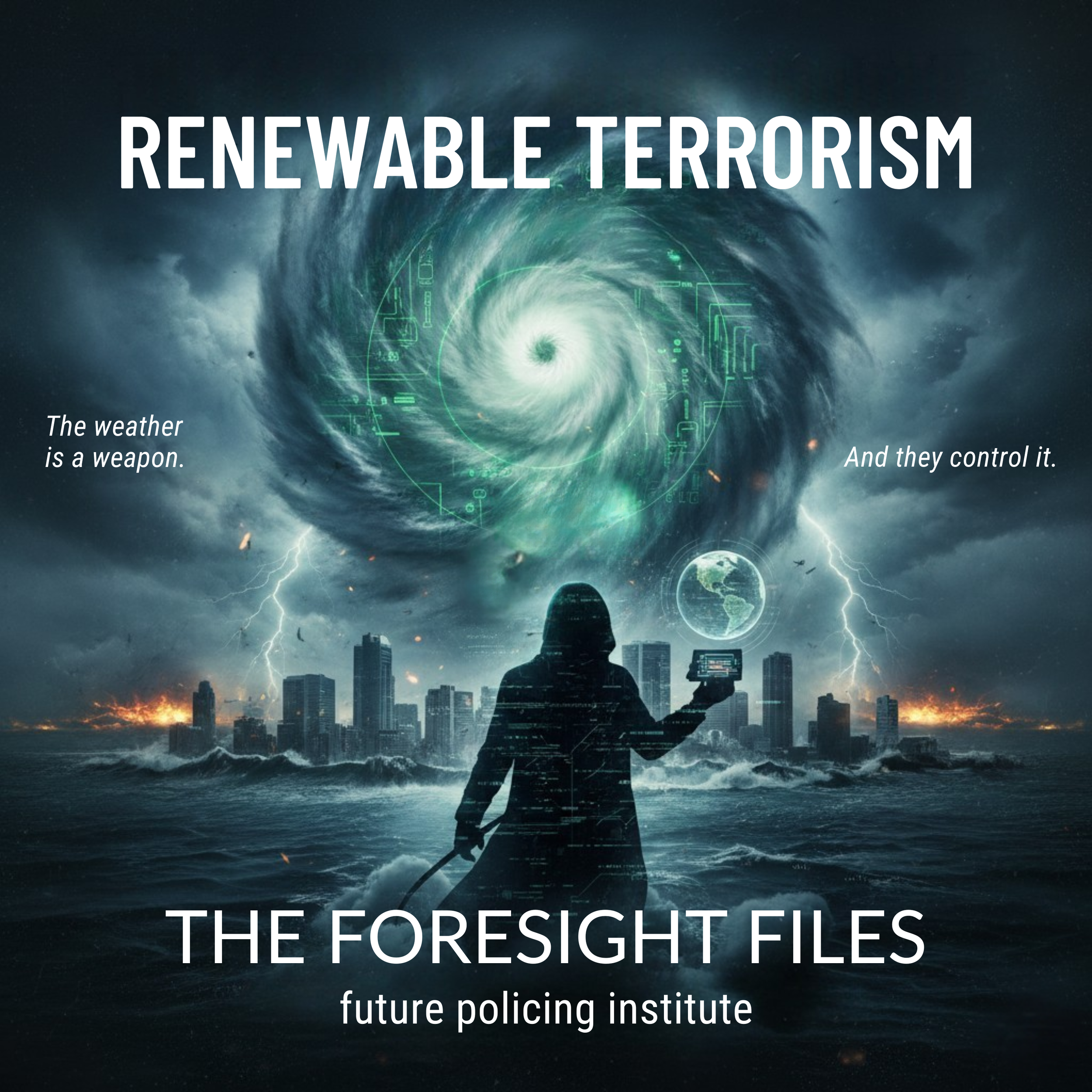
And the world watched, helpless, as the elements turned against them.
In the year 2037, the skies were no longer passive. They had become programmable, weaponized, and terrifyingly profitable.
The term “renewable terrorism” emerged after a series of unnatural disasters revealed a chilling truth: criminal syndicates had learned to manipulate the weather. What was once the domain of climate scientists and agricultural engineers — cloud seeding, atmospheric ionization, and geoengineering—had been hijacked by rogue technocrats and corporate saboteurs.
It began with the Southern Deluge.
A Category 5 hurricane, dubbed “Tempest Rex,” formed with eerie precision off the Gulf Coast. Meteorologists were stunned by its trajectory: it bypassed oil rigs and military installations, instead targeting low-income neighborhoods and critical infrastructure in Texas, Louisiana, Mississippi, and Florida. As emergency services scrambled to rescue thousands from rising waters, a wave of coordinated looting swept through the submerged cities. Banks were emptied, data centers compromised, and priceless artifacts vanished from museums.
Law enforcement was paralyzed. Helicopters were rerouted for rooftop rescues. Armored vehicles were stuck in flooded streets. Their mission had shifted from crime prevention to humanitarian triage.
Behind the chaos, the Stormfront Syndicate thrived.
This shadowy coalition of cybercriminals, corrupt developers, and rogue climatologists had discovered a lucrative formula: create a disaster, profit from the aftermath. Using advanced weather drones and hacked satellite systems, they could induce rainfall over specific regions, triggering floods that conveniently displaced populations and devalued land.
Then came the buyouts.
Inland properties — once considered remote and undesirable — were quietly purchased by shell companies. As coastal cities like Miami and Tampa were repeatedly battered, the shoreline crept inward. Soon, parts of Georgia and Alabama found themselves with ocean views. The value of these newly “beachfront” properties skyrocketed, and the Syndicate cashed in.
But not all crimes were soaked in water.
In the wake of the floods, white-collar criminals used the chaos to manipulate insurance markets, launder money through disaster relief funds, and push legislation that favored redevelopment contracts for their own firms. The very agencies meant to rebuild were being puppeteered by those who had orchestrated the destruction.
And then came the islands.
Inspired by China's artificial island-building campaign in the South China Sea, the Syndicate began constructing floating cities — massive, self-sustaining platforms equipped with luxury housing, data vaults, and private airstrips. These islands were strategically placed in newly flooded zones, claiming sovereignty over waters that had once belonged to coastal states. Built from recycled ocean plastics and reinforced with climate-adaptive tech, they were marketed as havens for the ultra-wealthy and safe zones from rising seas.
But they were more than real estate.
They were fortresses — immune to jurisdiction, patrolled by private security forces, and shielded by international ambiguity. From these floating strongholds, the Syndicate launched their next phase: controlling trade routes, manipulating maritime law, and even hosting offshore data markets where stolen information was auctioned to the highest bidder.
Then, the Syndicate revealed itself.
In a live broadcast hijacked across every major network, a masked figure stood before a digital map of the United States, animated with shifting coastlines, storm paths, and blinking icons of floating islands. The voice was synthetic, but the message was clear:
“We are the architects of the new world. You called it climate change. We call it opportunity. While your governments debated carbon credits, we rewrote geography. Florida is gone. Georgia is beachfront. And soon, the Carolinas will be islands of luxury. We are not terrorists. We are visionaries. We do not destroy—we redesign.”
Then the map zoomed out, revealing new targets: the Pacific Northwest, the Rockies, the deserts of the Southwest. The voice continued:
“You’ve seen what we can do with water. Next comes fire. Drought. Earthquakes. Tsunamis. We will ignite forests, fracture fault lines, and summon waves to erase borders. Your planet is programmable. Your future is negotiable. And we hold the code.”
The broadcast ended with a chilling slogan: “Nature is the canvas. We hold the brush.”
Public panic erupted. Markets crashed. Insurance companies froze payouts. Governments scrambled to regulate weather tech and maritime sovereignty, but the damage was done. Cities were gone. Coastlines redrawn. Trust in natural order shattered.
Policing was forced to evolve.
Traditional crime-fighting was no longer enough. Officers needed degrees in meteorology, cyber forensics, and environmental law. Patrol cars were replaced with amphibious drones. Surveillance now included atmospheric scans, oceanic mapping, and predictive weather modeling. The badge had become a beacon in the storm — both literal and metaphorical.
But The Syndicate remained untouchable.
They didn’t hide in bunkers or encrypted chatrooms. They lived in penthouses on floating islands, sipping champagne as the tides rolled in. Their crimes were invisible, their weapons disguised as clouds, their fingerprints scattered in the wind.
And the world watched, helpless, as the elements turned against them.
Discussion Questions
How must law enforcement evolve to respond to crimes involving climate manipulation and geoengineered disasters?
In disaster zones where humanitarian aid and crime prevention overlap, how should policing prioritize its role?
What legal and jurisdictional challenges do floating islands and artificially created territories pose for law enforcement?
What investigative strategies or intelligence frameworks are needed to track and counter these evolving threats?
How can agencies maintain operational integrity when infrastructure, communication, and public trust are compromised?
Author’s Note
Lately, the nightly news has felt less like reporting and more like foreshadowing. Above-the-fold headlines are dominated by natural disasters — floods, droughts, wildfires, earthquakes, tsunamis, and relentless heat waves. I watch law enforcement vehicles wade through submerged streets, guarding devastated neighborhoods from looters. Then come the geopolitical segments: China building floating islands in the South China Sea — strategic, calculated, and unsettling. It all feels like part of a larger, invisible blueprint. Add to that the rise of eco-terrorism, with groups like the Earth Liberation Front making headlines. But what if the ideology shifted — less activism, more profit? Crime syndicates exploiting environmental chaos not to save the planet, but to monetize its destruction. Even in Georgia, where clashes over the “Cop City” training facility have led eco-protesters to torch construction equipment, the irony is stark: in trying to protect nature, they’re poisoning it.
This fictional story captures one possible future. I hope it causes you to think deeply about the multitude of implications to advancing technology, organized crime, and the tremendous impact our changing climate will have on all of us.
About the Author
Craig T. Solgat is a Captain with the Metropolitan Police Department of Washington, DC. He is also a published author whose work has appeared in numerous professional journals, contributing valuable insight on public safety, national security, and police leadership. To read his full bio, click here.