
Ethical Fading and the Future of Policing
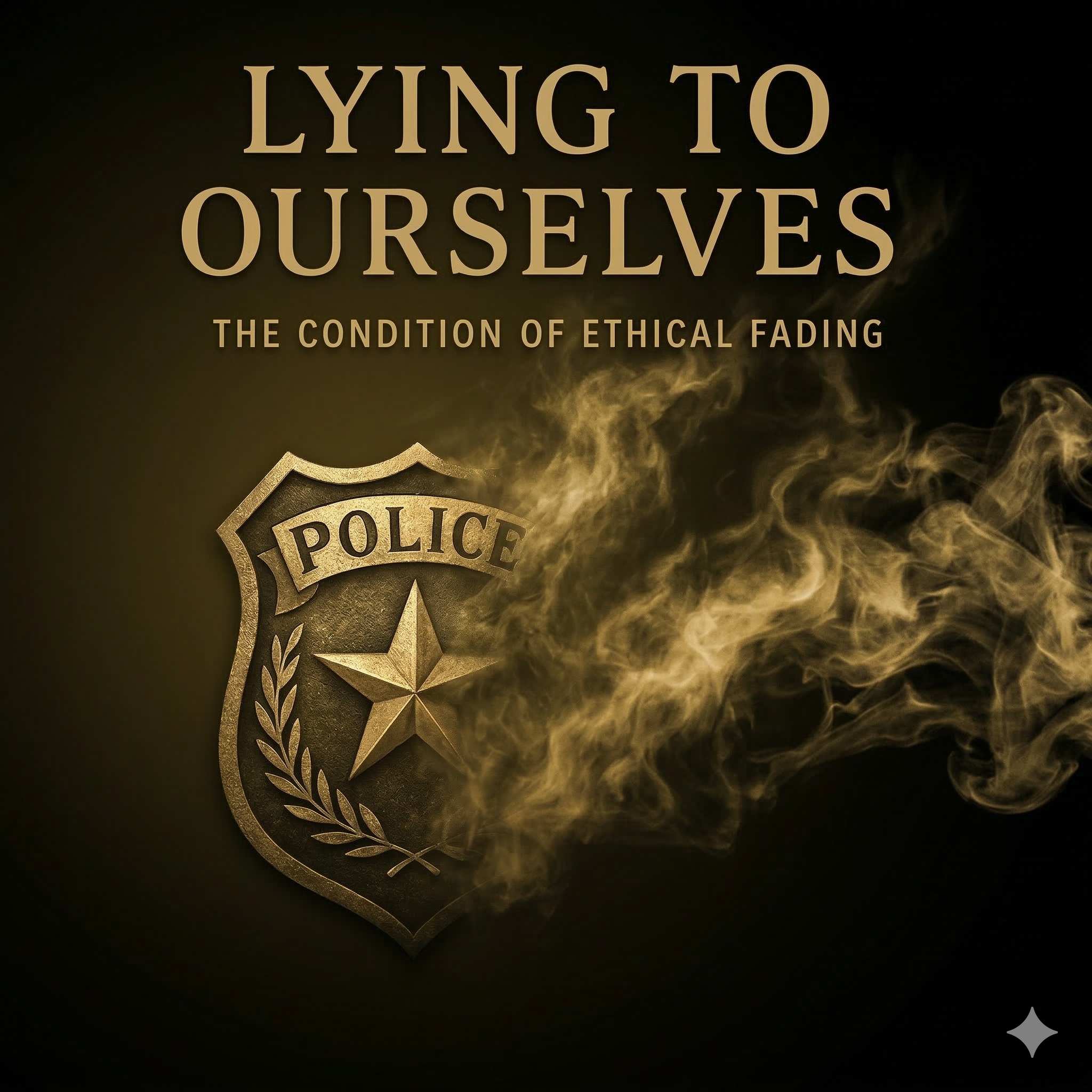
“The question is no longer whether ethical fading exists in policing. The real question is how long will it be tolerated and what that tolerance will cost the profession, the public, and the legitimacy of law enforcement itself in the future.”
Policing has not lacked ethics training, policy reform, or leadership development. What it lacks is a full reckoning with why integrity failures persist despite all three.
The problem is not always ignorance. Often, the deeper issue is that people stop seeing the ethical dimension of their own conduct. The moral stakes do not disappear. They simply fade from view. Social psychologists call this ETHICAL FADING, a process in which self-interest, pressure, habit, or institutional culture gradually obscure what should be morally obvious.
That process matters. Ethical fading does not remain confined to private judgment. It spreads. What begins in the mind of an individual can shape hiring decisions, training practices, operational habits, supervisory incentives, and institutional culture. Left unchecked, ethical fading weakens accountability and erodes the legitimacy on which policing depends.
If policing is serious about rebuilding trust, it must confront ethical fading as a professional problem, not a personal flaw. The work begins with the individual, but it does not end there.
Where It Starts: The Individual
Ethical failure does not begin with the institution. Ethical failure begins with the individual. Every person in policing, regardless of rank, makes decisions with moral consequences.
Traditional ethics instruction often assumes that if people understand the ethical dimensions of a decision, they will choose the right path. That assumption misses a more uncomfortable reality. People do not always act unethically out of open malice or clear intent. More often, they persuade themselves that nothing unethical is happening at all.
That is the essence of ethical fading. The moral dimension of a decision recedes, while self-serving conduct becomes easier to justify. In that moment, a person can act against stated values while still believing those values remain intact. The danger lies not only in the act itself, but in the illusion of integrity that makes the act feel acceptable.
Who We Admit: Hiring Practices
If ethical fading begins with the individual, hiring is the first chance to shape an agency’s ethical future. People do not enter policing as blank slates. They arrive with habits, values, and patterns of judgment already taking form. Hiring is not only about filling vacancies. Hiring is about deciding who will be entrusted with professional authority.
Other high-trust professions approach that responsibility with greater consistency. Nursing offers a useful contrast. For twenty-three consecutive years, national polling has ranked nursing as the most trusted profession. That standing reflects more than bedside skills. It reflects a profession with more uniform expectations around education, licensure, screening, and professional conduct.
In nursing, hiring processes often assess judgment, accountability, and professionalism alongside technical competence. Ethical failure is not treated as abstract or distant. Ethical failure is understood as conduct that can end a career.
Law enforcement remains far more fragmented. Hiring standards vary widely across departments and across local, state, and federal systems. One agency may use structured interviews, deep background investigations, social media review, and meaningful reference checks. Another may rely more heavily on minimum qualifications, physical standards, and staffing urgency. Even within legal and contractual limits, agencies still have room to assess character more deliberately.
That point matters. Ethical culture is shaped, in part, by the people admitted into the profession and the values they carry with them. If policing wants fewer ethical failures later, it must place greater weight on integrity, accountability, and judgment at the point of entry.
What We Reinforce: Training
Once recruits enter the academy, the challenge becomes more immediate. In many agencies, ethics and integrity remain confined to a short block of instruction early in training. That approach is not enough to build durable professional standards.
Ethical reasoning should be reinforced throughout the curriculum. Recruits should repeatedly encounter how values shape decisions in report writing, use of discretion, courtroom preparation, supervision, and community encounters. Repetition matters. Misconduct often begins not with openly bad intent, but with rationalization.
One form of rationalization is noble cause corruption, the belief that bending rules are acceptable if it serves a perceived greater good, such as protecting the public or securing a conviction. Even routine topics should address that danger directly. Recruits should be shown how seemingly minor distortions in a report or statement can become career-ending acts of dishonesty once exposed.
Training can also be borrowed from other professions. Aviation improved safety by encouraging early disclosure of errors and near misses through anonymous and nonpunitive reporting systems. A similar reporting pathway in academic culture could give recruits a way to raise ethical concerns, training inconsistencies, or peer misconduct without fear of retaliation. When ethics instruction is continuous and reporting is trusted, integrity stops looking like a one-time lesson. Integrity becomes part of daily practice.
What Becomes Normal: Operations
Ethical fading becomes especially dangerous in daily operations, where repeated decisions begin to define what feels normal. Officers are no longer learning standards in theory. Officers are exercising authority in real settings, often under pressure and with limited supervision.
In that environment, misconduct can become routine. This behavior is rarely introduced as misconduct. More often, the behavior is explained as necessary, expected, or simply part of the job. Rationalizations such as “everyone’s doing it,” “management expects it,” or “it’s for the greater good” make questionable conduct easier to repeat.
Language deepens the problem. Euphemisms soften misconduct and obscure its meaning.
Harassment becomes “aggressive tactics.”
Coerced confessions become “interrogation.”
Statistical manipulation becomes “crime reduction.”
Once that language takes hold, misconduct is no longer treated as exceptional. Misconduct becomes ordinary. That normalization is corrosive. It erodes trust, weakens accountability, and gradually alters the profession’s moral baseline.
What Gets Rewarded: Supervision
Supervisors can either interrupt ethical fading or accelerate it. Too often, performance systems do the latter. Weekly, quarterly, and annual metrics can pressure managers to cut corners, shade the truth, or reward appearances over honesty.
When unethical behavior leads to praise, promotion, or relief from scrutiny, the message is unmistakable: results matter more than integrity. At the same time, those who report unfavorable but accurate outcomes may be criticized, while those who manipulate information are rewarded.
That imbalance creates dangerous incentives. For example, a ranking member who reports zero burglaries after claiming one hundred overnight business checks may be praised, even if the checks never occurred. Another ranking member may report zero burglaries with zero checks and be judged negatively. The outcome is the same, but the lesson is not. Systems like that do not merely tolerate deception, they teach it. Over time, the pursuit of favorable metrics can replace the pursuit of truth. The result may look like success on paper, but the cost is paid in integrity, public trust, and institutional legitimacy.
When the Culture Absorbs It: Institutions
At the institutional level, policing depends on integrity and honesty, and public trust depends on the belief that law enforcement will uphold those values. That trust does not require perfection. That trust requires truthfulness, especially when outcomes are imperfect.
When ethical fading spreads through an agency, the problem is no longer limited to individual judgment. The problem becomes cultural. Repeated exposure to misconduct can dull sensitivity to wrongdoing, shift investigative baselines, and make serious concerns seem routine or manageable.
That cultural drift can affect agencies of any size. In larger departments, the problem may reach specialized accountability units such as Internal Affairs. In smaller departments, supervisors, command staff, or other ranking members often investigate the conduct of their own members. In either setting, repeated exposure to misconduct can distort judgment and lower standards.
Institutional pressure can make the problem worse. Leaders and investigators may feel pressure to protect the agency, preserve morale, avoid political fallout, or respond to public outrage. Under those conditions, investigations can drift away from objective fact-finding and toward justification, minimization, or strategic blame. When investigative outcomes are bent to fit agency interests or public sentiment, ethical fading has become part of the institutional culture itself.
What a Stronger Model Looks Like
Law enforcement does not need to solve these ethical challenges from scratch. Useful models already exist in professions that have built ethical discipline into their standards, oversight, and daily practice.
Nuclear operators offer one example. In the nuclear field, ethical standards are reinforced through procedural compliance, accountability, and constant vigilance. The U.S. Nuclear Regulatory Commission supports that culture through licensing, inspection, and enforcement. The system makes expectations clear. Not only is deliberate misconduct forbidden, materially incomplete or inaccurate information is also prohibited. Furthermore, workers who raise safety concerns are protected from retaliation. The larger lesson is that trustworthy professions do not treat character and competence as separate matters. A worker who hides safety concerns, falsifies information, ignores procedures, or punishes someone for speaking up is not seen as merely flawed in judgment. That conduct is treated as incompatible with professional fitness.
Law enforcement needs the same earnestness. Ethical hiring, integrated training, and forward-looking accountability are not optional. Those measures are part of what legitimacy requires. If policing wants to reduce ethical fading, integrity must be reinforced as a professional standard of all members and at every level of the institution.
The Real Question
The question is no longer whether ethical fading exists in policing. The real question is how long will it be tolerated and what that tolerance will cost the profession, the public, and the legitimacy of law enforcement itself in the future.
The time for hesitation has passed. Policing must draw from proven models of integrity and build a culture in which honesty is consistently expected, reinforced, and protected. Ethical fading is not an occasional lapse. Ethical fading is a systemic threat. Confronting that threat will require clarity, transparency, and the moral resolve the public rightfully expects.
About the Author
Captain Craig T. Solgat serves with distinction in the Metropolitan Police Department of Washington, DC, where he brings over two decades of law enforcement experience and leadership to the nation’s capital. He is also a Fellow of the Future Policing Institute. He holds a Master of Arts in Homeland Defense and Security from the United States Naval Postgraduate School and a Bachelor of Arts in Criminal Justice from Michigan State University. He is also a published author whose work has appeared in numerous professional journals, contributing valuable insight on public safety, national security, and police leadership. To read his full bio, click here.