
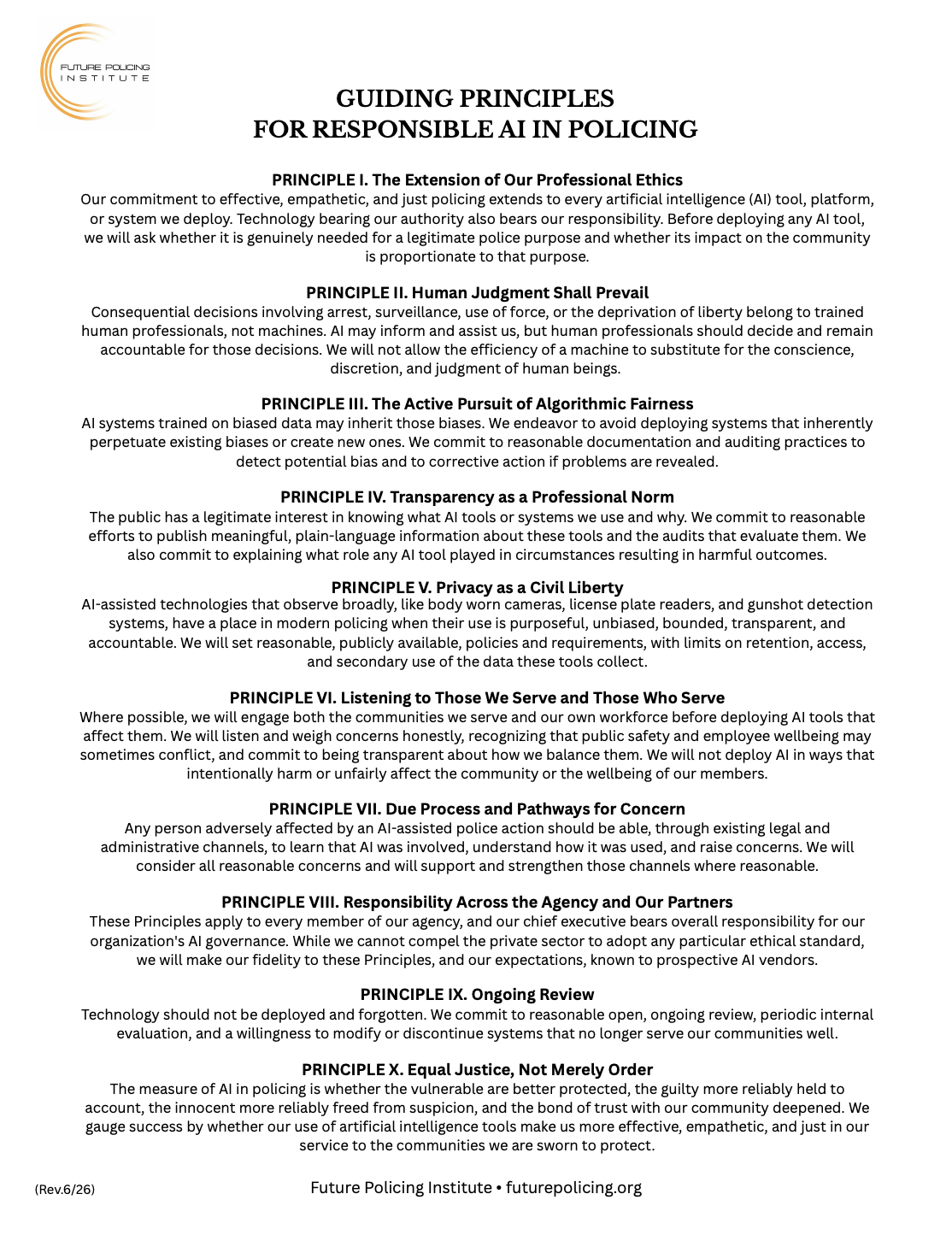
Guiding Principles for Responsible AI in Policing
By adopting these principles, police leaders guarantee that their communities experience policing that is more effective, empathetic, and just.
Artificial intelligence is no longer a futuristic concept for law enforcement; it is deeply embedded in American policing today. Agencies are rapidly acquiring AI tools to identify crime patterns and reduce administrative workloads, but this technology is advancing much faster than professional standards or legal frameworks. Because AI can actually shape officer discretion and direct police work rather than just support it, clear professional rules are urgently needed. The Guiding Principles for Responsible AI in Policing were created to provide this essential ethical foundation before courts, advocacy groups, or legislators define the rules instead.
The Guiding Principles serve as a professional framework for police leadership and governance. They do not replace local laws or agency policies, but rather establish a common ethical baseline built on the concept of reasonableness. Importantly, these guidelines do not ask law enforcement to invent new ethics. They directly extend the longstanding commitments of the Law Enforcement Code of Ethics into the digital age. By adopting this framework, a chief executive commits to applying traditional values like impartiality, integrity, and accountability to a new generation of technology.
At the core of this framework is the absolute rule that human judgment must prevail. Consequential decisions regarding arrests, use of force, or the deprivation of liberty must always belong to trained professionals rather than machines. The principles also require agencies to actively pursue algorithmic fairness through regular auditing, acknowledging that AI systems can inherit dangerous biases from their training data. Additionally, the framework demands transparency as a professional norm, requiring agencies to publish plain-language information about the tools they use and engage honestly with their communities before deployment.
For police leaders, the immediate value of these principles is practical guidance. Agencies face intense pressure from vendor promises and tight budgets, and this framework provides a clear way to make responsible choices about acquiring and governing new systems. Following these standards also helps protect forward-thinking agencies. By establishing clear AI governance now, departments are better prepared to defend their decisions in court or community meetings. They ensure that policing standards are driven by shared public values rather than contractual gaps or vendor preferences.
Ultimately, the true value of the Guiding Principles is ensuring that technological progress serves the public good. The framework emphasizes that the goal of AI in policing is equal justice, not merely public order. A successful AI deployment is one where the vulnerable are better protected, the guilty are reliably held accountable, and the innocent are freed from suspicion. By adopting these principles, police leaders guarantee that their communities experience policing that is more effective, empathetic, and just.
To download a copy of the Principles, click here.